





Breaking the Snacking Autopilot: Are Your Eating Habits Working for You?

Perry Nixdorf, Admin Posted on Aug 25, 2025 05:56 PM
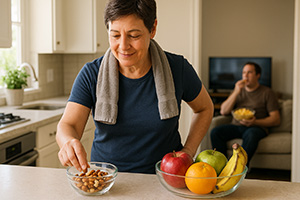
You come home from work, kick off your shoes, settle into your favorite chair, and have a drink. Then dinner. Later, you’re watching your evening show with a bowl of something nearby.
Meanwhile, earlier in the day, lunch was coffee and whatever you could grab between appointments.
Sound familiar?
There’s nothing inherently wrong with dinner, an evening snack, or enjoying food with other people. But it’s worth asking whether you’re choosing those meals or simply following a routine you haven’t questioned in years.
The problem isn’t that food turns bad when you sit down. It’s that automatic habits can make your eating pattern very different from the one you meant to have.
When the activity becomes the appetite
Think about the situations you connect with food.
A movie means popcorn. A break means something sweet. Sitting down after a hard day means opening a bag before you’ve decided whether you actually want what’s inside.
At the other end of the day, being busy may mean putting off meals until you finally stop moving.
None of that makes you undisciplined. It gives you something specific to look at.
You might find that you really enjoy your evening snack. You might also find that you barely notice eating it.
Those are different experiences, and you’re allowed to make different choices about them.
Your body doesn’t follow an “active or resting” food rule
It’s tempting to make the solution simple: eat when you’re about to move, stop eating when you’re about to rest.
Meal timing isn’t that tidy.
In one controlled study published in Cell Metabolism, people on calorie-matched weight-loss diets lost about the same amount of weight whether most of their calories came at breakfast or at dinner. Their energy expenditure didn’t differ either. The breakfast-heavy group did report less hunger, which could make that approach easier for some people to stick with.[nih]
That’s a more useful takeaway than declaring dinner a metabolic mistake. Changing when you eat may help you manage hunger, but it isn’t a guarantee.
Fuel your exercise without making every walk a nutrition project
If your eating pattern leaves you hungry and dragging through exercise, it deserves attention. That doesn’t mean everyone needs the same snack before every activity.
Exercise nutrition covers fuel for the activity and nutrients for recovery. The American Heart Association describes carbohydrates as the main fuel for working muscles and protein as helping muscles repair and grow afterward. It also notes that you don’t need to eat during a workout of an hour or less.[heart]
So “Should I eat protein before I move?” is too narrow a question.
More useful questions include:
- When did I last eat?
- What activity am I planning?
- How do I usually feel during that activity?
- Does eating close to exercise feel comfortable?
- Am I regularly skipping meals and trying to make up for it later?
If exercise nutrition feels confusing, a registered dietitian can help you build an approach around your goals instead of a one-size-fits-all snack rule.
The aim is a pattern that works for you, not another reason to worry that you’re doing fitness wrong.
Evening eating isn’t automatically the problem
An evening meal can be satisfying, social, and completely intentional.
What deserves a closer look is the extra eating you didn’t especially want: finishing the leftovers while cleaning up, grazing through a TV show, or going back to the cupboard again and again because the day finally slowed down.
You don’t need to blame the clock to notice those habits.
Setting an eating window helps some people, but it isn’t a magic switch. In a year-long randomized trial in the New England Journal of Medicine, people who ate only between 8 a.m. and 4 p.m. while cutting calories didn’t lose significantly more weight than people who cut calories without a time limit.
An earlier stopping time can be a helpful personal boundary. It shouldn’t turn into a belief that every bite after a certain hour becomes body fat.
Use a food diary to spot your patterns
You don’t have to rely on memory. Try writing down what you eat and drink for a few days.
Food diaries, called dietary self-monitoring in research, are a standard part of weight-management programs. A systematic review in the Journal of the American Dietetic Association found a consistent link between self-monitoring and weight loss, though the authors noted that weaknesses in the studies limited the strength of the evidence. A later review of digital tracking found that people who tracked more often generally lost more weight.[nih +1]
One caution: in those studies, tracking was usually one part of a larger program. The diary helps because of what you do with what you learn, not because writing things down works some kind of magic.
For this experiment, start with awareness rather than exact calorie counts. For each meal, snack, or drink, write down:
- What you had, roughly.
- About what time it was.
- Whether you were hungry beforehand.
- What you were doing: working, watching TV, socializing, driving.
- How satisfied you felt afterward.
You’re looking for patterns, not building a case against yourself.
Maybe lunch keeps disappearing from your schedule. Maybe you enjoy your evening snack and feel satisfied afterward. Or maybe you discover you’re eating through a whole TV show without paying much attention to the food.
Start with what your notes actually show, not what an article says must be wrong.
Change one habit you actually want to change
Once you’ve spotted a pattern, choose one small experiment.
You could:
- Set aside time for the lunch you usually skip.
- Put an evening snack in a bowl instead of eating from the package.
- Eat one meal a day without a screen.
- Decide whether you want food before automatically taking it to the couch.
- Plan meals more deliberately on days you exercise.
Pick the change that fits your pattern. You don’t need to do all of them.
Keep using your food diary for another few days, then look back. Did you enjoy your food more? Was your routine easier to manage? Did you feel less rushed or less preoccupied with eating?
Keep what’s useful. Adjust what isn’t.
Don’t turn this into a longevity promise
Fasting and calorie-restriction research is interesting, but it doesn’t show that skipping your evening snack will help you live longer.
The National Institute on Aging notes that more research is still needed to determine whether calorie restriction extends lifespan or healthspan in humans.[nih]
You don’t need an anti-aging promise to justify a sensible change. A more deliberate, manageable relationship with food is worth having on its own.
Your next step
Start your food diary today. Keep it simple and stick with it for three or four days.
Then pick one eating habit you’ve been following on autopilot. Not your whole diet. Not every meal. One habit.
Ask yourself: “Do I enjoy this? Does it fit what I’m trying to accomplish? Or am I doing it because it’s what I always do?”
You can keep dinner with friends. You can keep the popcorn you really enjoy.
The goal isn’t to take the pleasure out of eating. It’s to put more of the choice back in your hands.